Sumeru
The Eight Mountains: A NovelSumeru is the central mountain in a cosmological story that Pietro hears, remembers, and later retells to Bruno. Though it is not presented as a destination in the Alps, its summit gives the story a way to compare journeys across many mountains with the pursuit of one central height—and, finally, to consider what counts as a good achievement.
Cosmological Definition
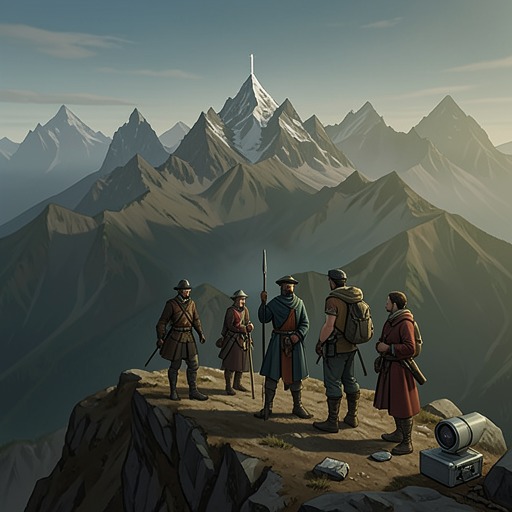
The chicken carrier describes Sumeru as a tremendously high mountain at the center of the earth. Eight mountains and eight seas surround it, forming the world represented in his drawing. While explaining, he adds a peak to each spoke of a wheel, a wave between each pair of peaks, and a crown at the center for Sumeru’s summit. The image is both a diagram of a world and a compact story about how that world might be traversed.
The carrier asks which traveler has learned more: the person who has been to all eight surrounding mountains, or the one who has reached Sumeru’s summit. The question leaves the measure of achievement open. It sets breadth of experience against the singular accomplishment of reaching the center, without resolving the choice into a simple ranking.
The Drawing and Its Afterlife
The image is temporary: after telling the story, the chicken carrier rubs the drawing away with his hand. Pietro nevertheless knows he will remember it, and thinks it will be a good story to tell Bruno. The episode makes Sumeru a place carried forward not by a surviving map, but by memory and retelling.
That contrast has particular resonance in a novel where mountains also endure in physical records. Pietro finds his father’s old map transformed by twenty years of colored routes into something like a biography; later, he discovers Giovanni Guasti’s summit entry in a weather-damaged notebook. Those records preserve actual climbs, while the Sumeru drawing preserves a way of thinking about journeys and their meaning. The two forms of memory differ, but each lets an absent person or experience remain present.
Sumeru Retold to Bruno
Pietro recalls the legend when Bruno is deeply discouraged. Trying to lift his friend’s spirits, he scratches the mandala onto a wooden tile with a nail and retells the story, attempting to reproduce the chicken carrier’s words and gestures. Bruno interprets the comparison by casting Pietro as the traveler to all eight mountains and himself as the climber of Sumeru. When Bruno asks which of them achieves something good, Pietro answers that Bruno does—not merely to encourage him, but because he believes it.
The retelling turns the original question into an intimate exchange. Sumeru’s summit is no longer only one possible measure of learning; it becomes part of a story the friends use to understand their different paths. Bruno studies the drawing to memorize it, pats Pietro on the back, and leaves. The tale does not erase his despondency, but it gives the two friends a shared image through which Pietro can affirm Bruno’s worth.
Narrative Significance
Sumeru’s importance lies less in geographical description than in its function as a portable center: the mountain at the middle of a drawn world becomes a point of comparison that can be recalled far from the first telling. The erased mandala survives in Pietro’s memory, then takes on renewed force when he draws it again for Bruno. Its return shows how a story can change with its audience: a question about which journey teaches more becomes an act of recognition between friends.
The legend also resists a single, measurable definition of achievement. Its two routes—visiting all eight mountains or climbing Sumeru—remain distinct, and the answer Pietro gives Bruno arises from his conviction about his friend, not from a rule supplied by the cosmology. Sumeru therefore serves as both the summit at the center of the tale’s world and the occasion for a personal judgment that the tale itself cannot settle.